
MindChat Review
A FastAPI + Groq mental-health chatbot with crisis detection and a responsive web UI.
Each review covers deployability, value versus commercial alternatives, and privacy model. Tools that can run locally were started and exercised; mobile or backend-dependent tools were assessed from published builds, source code, and deploy guides. Ratings reflect what we were able to verify.
MindChat — Open Source Mental Health Chatbot
A FastAPI + Groq mental-health chatbot with crisis detection and a responsive web UI. Last updated: 2026-06-21.
One-sentence verdict: A clean, minimal chatbot prototype with crisis-detection hooks; best suited as a starting point for developers, not as a daily mental-health companion.
What the System Is
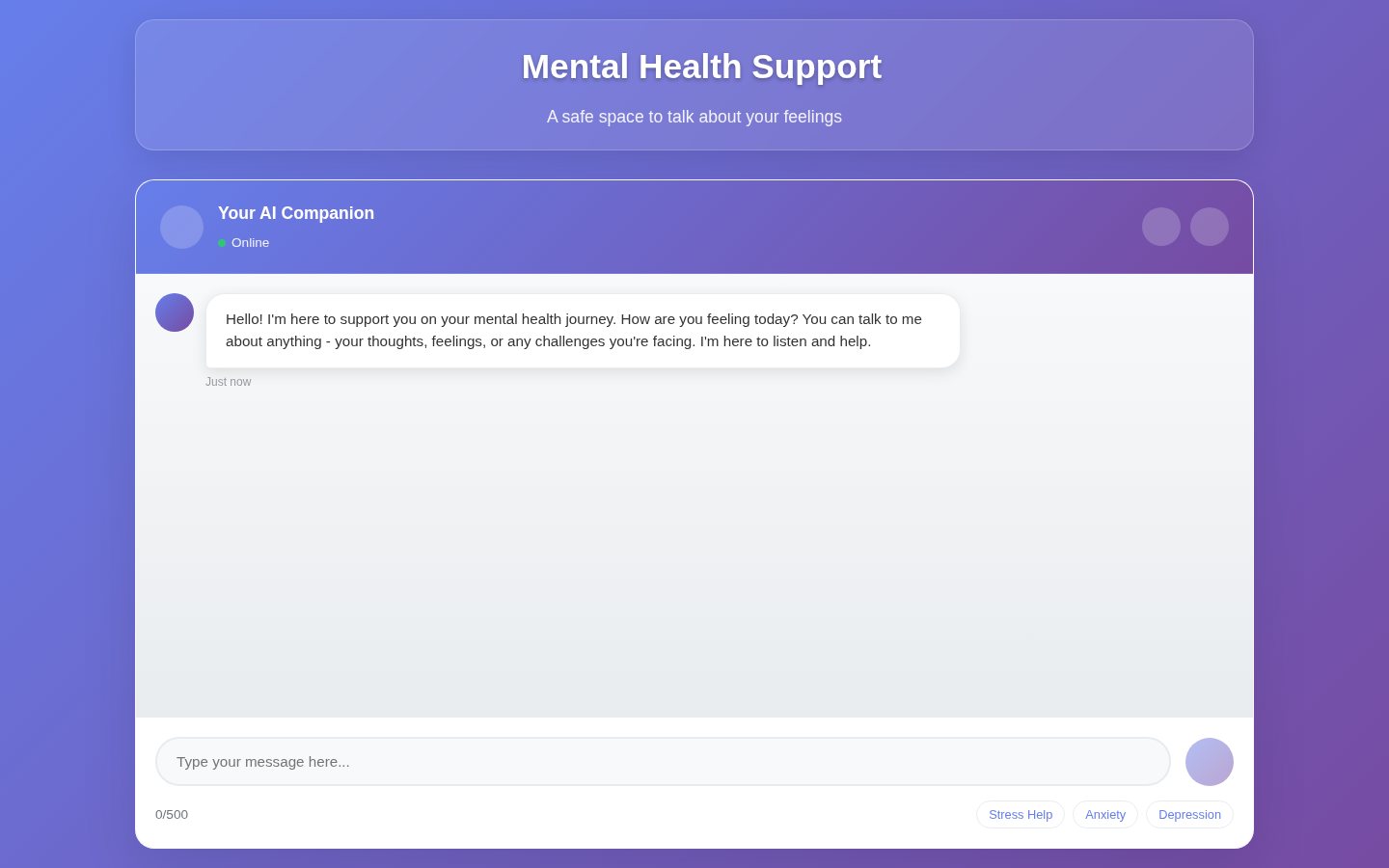
MindChat — published as AI-Mental-Health-Chatbot — is a Python FastAPI app with a small HTML/CSS/JS frontend. The documented capabilities include:
- Conversational AI via Groq API (cloud LLM).
- Crisis detection that triggers safety messages and helpline prompts.
- Session management with per-session chat history.
- Document Q&A over a small bundled stress-management text file.
- Dark/light theme and responsive layout.
The backend is a single FastAPI file (main.py) plus modules for LLM service, crisis detection, and logging.
| Key data | |
|---|---|
| Category | Mental Health |
| Language | Python / FastAPI |
| License | Unknown |
| Self-hosted | Yes |
| AI provider | Groq API (LLaMA or other models) |
| Frontend | HTML / CSS / JS |
| Storage | In-memory / file-based session logs |
How to Install and Deploy
cd /data2/docker/going-global/repos/AI-Mental-Health-Chatbot
python -m venv .venv
source .venv/bin/activate
pip install -r requirements.txt

echo "GROQ_API_KEY=your-groq-key" > .env
# Optional: echo "HF_TOKEN=your-hf-token" >> .env

python run_server.py
# → http://localhost:8000
The run_server.py wrapper starts Uvicorn on port 8000.
How to Test
The documented test flow is:
- Open
http://localhost:8000. - Verify the landing/chat UI loads with the dark/light toggle.
- Start a chat session; actual AI replies require a valid
GROQ_API_KEY. - Test crisis detection by sending a message containing high-risk language; verify the app returns a safety message and helpline information.
- Try a stress-management quick-action button and confirm the response comes from the bundled
stress_management.txtresource. - Refresh the page and confirm session history is retained (based on the session implementation).
The app does not include authentication or persistent user accounts; sessions are tracked anonymously.
Privacy & Compliance
MindChat is not HIPAA compliant. Chat text is sent to Groq's cloud API. Session logs are local, but there is no encryption, access control, or audit policy. Do not use it for clinical PHI. Users who want a private alternative must replace the Groq backend with a local model.
MindChat vs Commercial Mental Health Apps
| Dimension | MindChat | Commercial Apps (e.g., Woebot, Wysa, Headspace) |
|---|---|---|
| Cost | Free / self-hosted | Subscription / freemium |
| AI model | Groq cloud LLM | Proprietary, often clinically guided |
| Crisis detection | Rule/keyword-based | Clinically validated escalation |
| Authentication | None | Account-based |
| Mobile apps | Browser responsive | Native apps |
| Evidence base | None claimed | Published studies for some |
Who Should Use It
- Developers building a crisis-aware chatbot UI.
- Teams that want a FastAPI + Groq integration example.
- Privacy-conscious users willing to replace Groq with a local LLM.
Who Shouldn't Use It
- Anyone in immediate crisis; call emergency services or a crisis line.
- Users seeking evidence-based digital therapy.
- Organizations needing HIPAA-compliant tooling.
FAQ
What LLM does MindChat use?
It calls the Groq API. You must provide a Groq API key in .env.
Does MindChat store chat history?
Sessions are tracked locally per session ID, but there is no user authentication or encrypted storage. Logs are not suitable for PHI.
Can I run it without Groq?
The chat backend is tied to Groq. To run fully offline you would need to swap llm_service.py for a local model integration.
Verdict
MindChat is a clean, minimal mental-health chatbot prototype with a responsive UI and crisis-detection scaffolding. It is a good FastAPI + Groq learning project, but it is not a substitute for clinically validated mental-health support.
Ratings: Deployability 4/5 · Value vs Commercial 2/5 · Privacy Compliance 2/5